
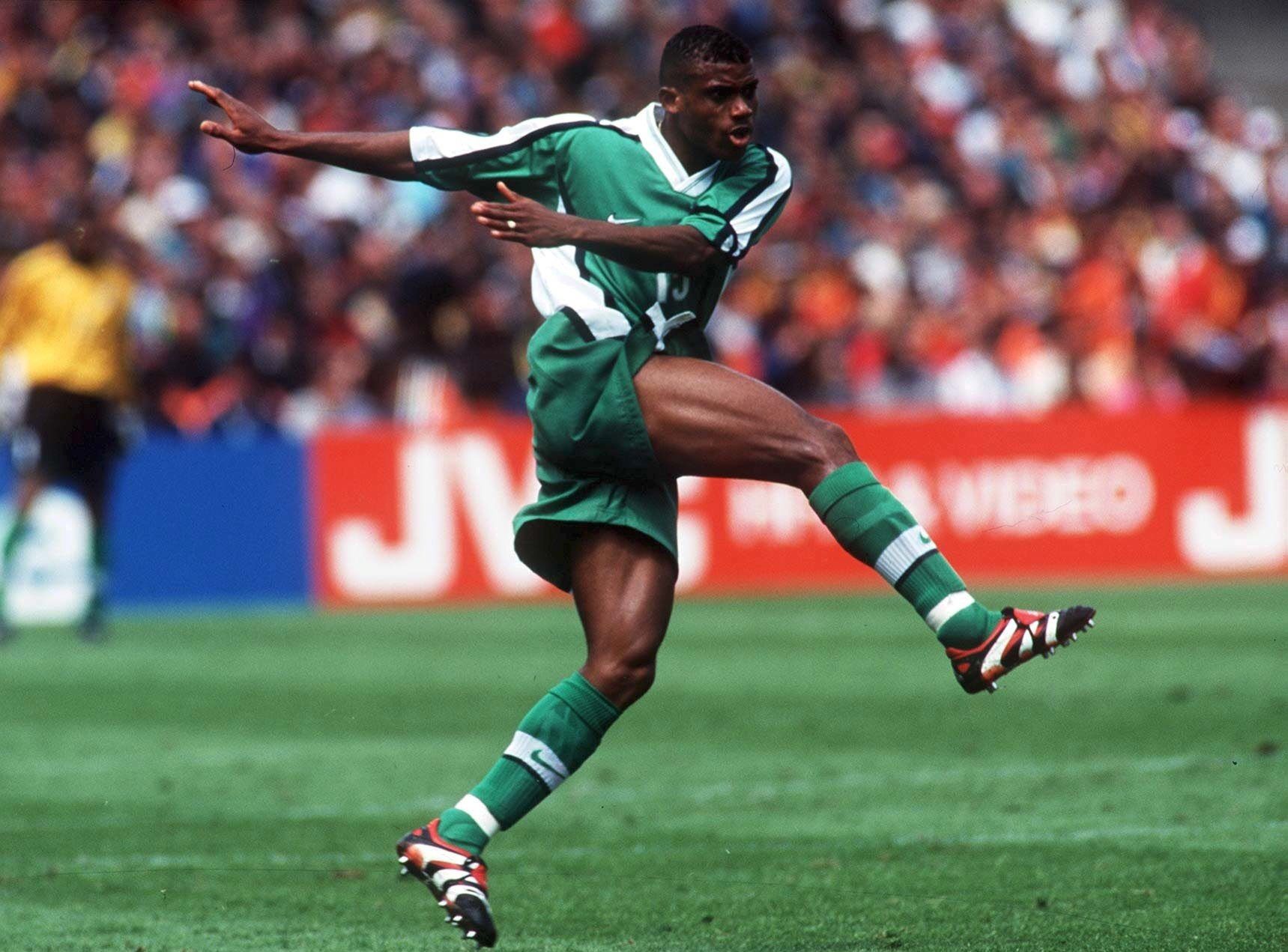
For many Nigerian football fans, few names bring back memories like Sunday Oliseh, Jay-Jay Okocha and Taribo West. They were part of a generation that gave Nigerians some of the most exciting moments in the history of the Super Eagles.
It was a team filled with confidence, character and extraordinary individual talent. But behind the memorable victories, incredible goals and spectacular displays was a dressing room full of strong personalities.
And according to Sunday Oliseh, one of the biggest sources of both excitement and frustration was none other than the legendary Austin “Jay-Jay” Okocha.
Okocha was a footballer blessed with a rare gift. His ability to dribble past opponents, control the ball in tight spaces and produce moments that left fans speechless made him one of Africa’s greatest-ever players. He was the kind of player who could turn an ordinary football match into a show.
But while fans enjoyed every dribble, step-over and piece of magic, some of his teammates sometimes saw things differently.
For Sunday Oliseh, playing alongside Okocha could occasionally be an emotional experience.
When Genius Becomes Frustrating
Football is a team sport, and while individual brilliance can win matches, every player is expected to understand the responsibilities of his position.
Sunday Oliseh was known for a completely different style of football from Okocha. Oliseh was disciplined, tactical and highly intelligent in midfield. He understood the importance of structure, positioning and moving the ball efficiently.
Okocha, on the other hand, represented freedom.
Give him the ball and anything could happen.
He could beat one player, beat another, turn back, drag the ball away from a defender and suddenly produce a pass that nobody in the stadium expected.
That unpredictability was what made him special.
However, it could also test the patience of teammates who wanted the ball released quickly.
Oliseh has recalled how difficult and frustrating it could sometimes be playing with a footballer as talented and unpredictable as Okocha. The frustration was not necessarily because Okocha lacked ability. In fact, the opposite was true.
Okocha had so much ability that he often attempted things other players would never even consider.
Sometimes, those decisions produced magic.
Other times, they produced frustration.
For a midfielder like Oliseh, who understood football from a tactical perspective, seeing a teammate hold onto the ball longer than necessary could be painful. Football moves quickly, and a delayed pass can affect an entire attacking movement.
But Okocha was not an ordinary player.
He played football with imagination.
And imagination does not always follow a tactical manual.
Jay-Jay Okocha: The Entertainer Who Changed African Football
To understand why Okocha’s teammates sometimes struggled with his style, it is important to understand the kind of player he was.
Jay-Jay was not simply a footballer who liked to dribble.
Dribbling was part of his identity.
He had the confidence to attempt skills in situations where most players would choose the safest option. He could embarrass defenders, excite supporters and completely change the mood inside a stadium with a single movement.
His famous saying, often associated with his reputation, was that he was “so good they named him twice.”
And for millions of fans, that confidence was justified.
Okocha was capable of doing things that made football look easy.
His performances for Nigeria, Paris Saint-Germain, Bolton Wanderers and other clubs established him as one of the most entertaining African players of his generation.
But every genius comes with a unique personality.
While a coach might be shouting, “Pass the ball!” Okocha might see an opportunity to beat one more defender.
While teammates were already making runs into space, Jay-Jay could decide that the moment required another touch.
Sometimes it worked perfectly.
Sometimes it drove his teammates crazy.
And that was where Sunday Oliseh’s frustration came in.
The Battle Between Structure and Freedom
Oliseh and Okocha represented two important sides of football.
Oliseh represented structure.
Okocha represented creativity.
A successful team needs both.
Without disciplined players, a team can become disorganised. Players must cover spaces, track opponents and maintain the shape of the team.
But without creative players, football can become predictable.
A player like Okocha could unlock a defence that seemed impossible to break down.
This created an interesting relationship inside the Super Eagles.
Oliseh wanted the team to function efficiently. Okocha wanted the freedom to express himself.
Neither approach was wrong.
In fact, Nigeria benefited from both.
The tactical intelligence of players like Oliseh helped give the team stability, while Okocha’s creativity provided moments of inspiration.
However, inside a competitive football environment, differences in style can create disagreements.
That is part of what makes football fascinating.
The same dribble that makes a fan jump from his seat can make a teammate shake his head in frustration.
The same risky pass that looks foolish when it fails can look like genius when it succeeds.
And with Jay-Jay Okocha, the line between genius and frustration was often very thin.
When Taribo West Almost Had Enough
If Sunday Oliseh sometimes found Okocha frustrating, Taribo West apparently had his own moments of impatience.
Taribo was known for his powerful personality both on and off the pitch.
As a defender, his football was built around strength, aggression and commitment. He was the type of player who took competition seriously and demanded the same level of seriousness from everyone around him.
So when Okocha decided to entertain himself with one dribble too many, Taribo was not always impressed.
According to Oliseh’s recollection, there was a moment when Taribo became so frustrated by Okocha’s “useless” dribbles that he nearly turned the situation into a physical confrontation.
For Taribo, football was not a circus.
There was a job to do.
Move the ball. Create chances. Win matches.
But Okocha could sometimes turn the football pitch into his personal stage.
And while supporters loved it, teammates who were focused on the tactical side of the game could lose patience.
The idea of Taribo West becoming angry with Jay-Jay Okocha may sound unbelievable to younger fans, but it also shows the intensity within that famous Super Eagles generation.
These were not players who were simply happy to wear the green and white jersey.
They were competitors.
They argued.
They disagreed.
They challenged one another.
But they also fought together for Nigeria.
Why Okocha Could Get Away With It
The truth is that Okocha’s talent gave him a certain level of freedom.
When a player repeatedly produces extraordinary moments, teammates and coaches often become more willing to tolerate his mistakes.
If an average player loses the ball after trying to dribble through three defenders, he may receive serious criticism.
But if Jay-Jay Okocha loses the ball trying something extraordinary, people might simply say, “That is Jay-Jay.”
That was the difference.
His ability meant that every risky decision carried the possibility of producing something special.
Football fans are willing to forgive creativity because creativity gives the game its beauty.
Nobody buys a ticket or sits in front of the television hoping to watch eleven players make safe passes for ninety minutes.
Fans want moments.
They want magic.
They want the unexpected.
And Okocha delivered exactly that.
Even when his teammates were frustrated, they knew that the same player who was holding onto the ball for too long could suddenly produce the pass or movement that changed the entire game.
The Reality of Playing With a Superstar
Playing alongside a superstar is not always easy.
Football history is full of examples of brilliant players whose personalities or styles created tension inside teams.
The best teams often contain players with completely different views of the game.
Some want discipline.
Others want freedom.
Some believe in simplicity.
Others believe in taking risks.
The challenge for a manager is finding the right balance.
Nigeria’s golden generation had plenty of big personalities, and that was both a strength and a challenge.
Players like Oliseh, Okocha and Taribo were all leaders in different ways.
They had different personalities and different approaches to football, but they shared one major objective whenever they wore the Nigerian jersey: winning.
That competitive environment could naturally create moments of tension.
But tension does not always mean hatred.
Sometimes, it simply means players care deeply about the result.
Taribo’s anger over unnecessary dribbles and Oliseh’s frustration with Okocha’s style can also be seen as evidence of how seriously they took the game.
The Super Eagles Were Bigger Than Individual Personalities
Despite disagreements and frustrations, the Nigerian national team produced unforgettable moments during that era.
The Super Eagles became known around the world for their confidence, flair and fearless approach.
Nigeria’s football was exciting because it combined physical strength, technical ability and individual creativity.
Okocha was the face of that creativity.
Oliseh represented intelligence and discipline.
Taribo brought strength and aggression.
Together with other members of that generation, they created a team that Nigerians still talk about decades later.
That is why stories from inside the team remain fascinating.
Fans often see only the ninety minutes on the pitch.
They do not always see the arguments during training, the tactical disagreements, the jokes in the dressing room or the frustrations that come with trying to manage several strong personalities.
Stories like Oliseh’s remind us that even legendary teams are made up of human beings.
Footballers get angry.
They disagree.
They become frustrated.
And sometimes, they almost fight.
But when the whistle blows, they must find a way to work together.
Was Okocha Too Much?
That question will always divide football fans.
Was Jay-Jay Okocha sometimes guilty of overdoing his dribbles?
Probably.
Did some of his decisions frustrate his teammates?
Almost certainly.
But would football fans have wanted Okocha to stop being Okocha?
Absolutely not.
His willingness to take risks was part of what made him special.
If coaches and teammates had completely removed his freedom, Nigeria might have lost some of the magical moments that made him a legend.
Great players are often difficult to fit into conventional systems because their talent goes beyond conventional thinking.
Okocha saw possibilities that other players did not see.
Sometimes those possibilities ended with the ball in the back of the net.
Sometimes they ended with an opponent taking the ball away.
That was the risk.
But that was also the beauty.
A Story That Shows the Human Side of Football
Sunday Oliseh’s recollection of playing with Okocha gives football fans another interesting look into the personalities behind one of Nigeria’s greatest football generations.
To the fans, Okocha was the magician.
To Oliseh, he could sometimes be a frustrating teammate.
To Taribo West, those unnecessary dribbles could apparently push patience to the limit.
But ultimately, these differences were part of what made that Super Eagles team unforgettable.
You had the disciplined midfield general.
You had the creative genius.
You had the aggressive defender.
Each player brought something different.
And somehow, those contrasting personalities came together to represent Nigeria on some of football’s biggest stages.
That is the beauty of football.
The players who frustrate their teammates can also be the same players who win them matches.
The dribble that looks unnecessary can suddenly become the moment everyone remembers.
And sometimes, the player you are shouting at during training becomes the hero you celebrate on match day.
For Sunday Oliseh, playing with Jay-Jay Okocha may have been frustrating and difficult at times.
For Taribo West, it may have required serious patience.
But for Nigerian football fans, those “useless” dribbles were often part of the magic.
And decades later, the names Sunday Oliseh, Jay-Jay Okocha and Taribo West still represent an unforgettable era of Nigerian football—an era filled with talent, passion, arguments, strong personalities and, above all, moments that will continue to live in the memories of football lovers for generations.